

What is Wet-Laid Nonwoven Fabric?
Features and Manufacturing Process, Applications and Next-Generation Technologies
Updated: 2026.02.13

Wet-laid nonwoven fabric is a type of nonwoven material manufactured using a liquid-based process known as the wet-laid method.
There are two primary manufacturing methods for nonwoven fabrics: the dry-laid process and the wet-laid process. The key difference between these two methods lies in how the fibers are formed into a sheet. In the dry-laid process, a web (fiber layer) is formed in air, whereas in the wet-laid process, fibers dispersed in a liquid are formed into a web in water by a papermaking technique similar to traditional Japanese washi paper production.
On this page, Hirose Paper Mfg. Co., Ltd.—a pioneer of wet-laid nonwoven fabrics in Japan with over 60 years of R&D and mass production experience—provides a detailed explanation of the features, applications, and manufacturing methods of wet-laid nonwovens.
目次
Features of Wet-Laid Nonwoven Fabrics
First, let us take a look at what wet-laid nonwoven fabrics are like, focusing on their structural and functional characteristics.
Wet-laid nonwoven fabrics are sheet-like materials with a smooth surface similar to paper. When viewed under magnification, they exhibit a structure in which elongated fibers are randomly entangled in the vertical, horizontal, and thickness directions.
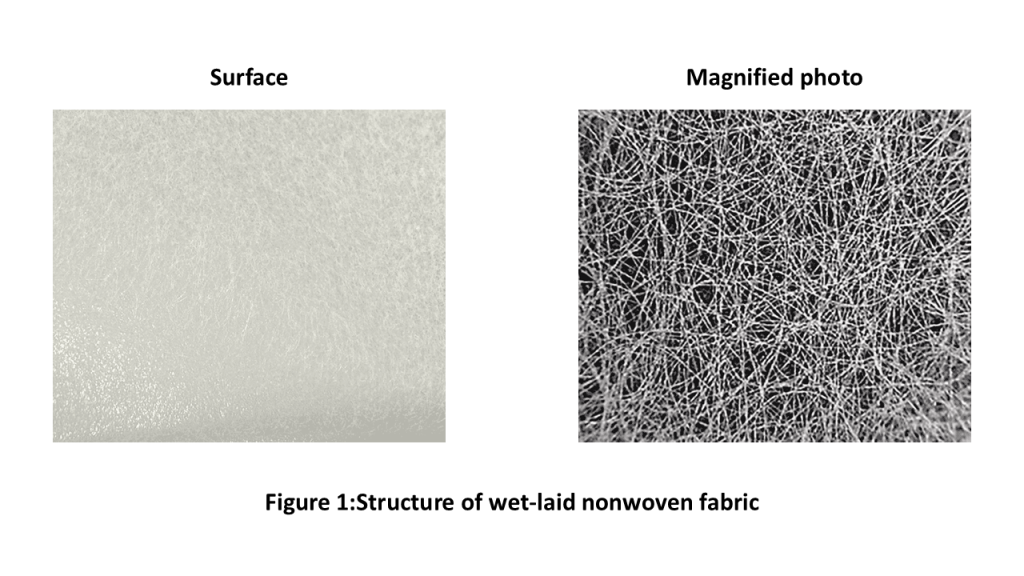
As mentioned above, the manufacturing method is similar to that of washi paper. Fibers used as raw materials are dispersed in a liquid such as water, then filtered on a forming wire to create a sheet.
Wet-laid nonwoven fabrics produced through this process have the following characteristics that are not found in dry-laid nonwovens:
- Extremely uniform fiber orientation, density, and pore size with minimal variation, resulting in a highly smooth surface
- Easy control of thickness, density, and porosity, enabling the production of ultra-thin or high-density sheets
- Capability to blend multiple raw materials or incorporate powders during sheet formation
- Manufactured using short fibers
- Paper-like texture (which can be modified to resemble fabric depending on processing)
| Dry-Laid Nonwoven (Dry Process) | Wet-Laid Nonwoven (Wet Process) | |
|---|---|---|
| Fiber Type | Mainly organic fibers | Both organic and inorganic fibers |
| Fiber Orientation | Aligned in one direction or random | Random |
| Fiber Diameter | Varies depending on the manufacturing process | Adjustable within a certain range |
| Fiber Length | Long fibers | Short fibers |
| Strength | High | Relatively lower than dry-laid |
| Texture | Stiff | Soft |
| Thickness | Thick | Thin |
Table 1: General Characteristics of Dry-Laid and Wet-Laid Nonwoven Fabrics
Wet-laid nonwoven fabrics are porous materials with voids between fibers, offering properties such as air permeability, filtration performance, moisture retention, and flexibility. In addition to plant-based fibers, a wide range of materials—including inorganic, organic, and metallic fibers—can be used as raw materials, enabling functional characteristics based on each material. Because they can be produced as thin as paper while providing advanced functionality, wet-laid nonwovens are also referred to as “functional paper.”
Manufacturing Process
Next, let us look at how wet-laid nonwoven fabrics are manufactured. Like other nonwoven materials, wet-laid nonwovens are produced in four main steps: raw material dispersion, web formation (forming fibers into a sheet), bonding, and finishing.
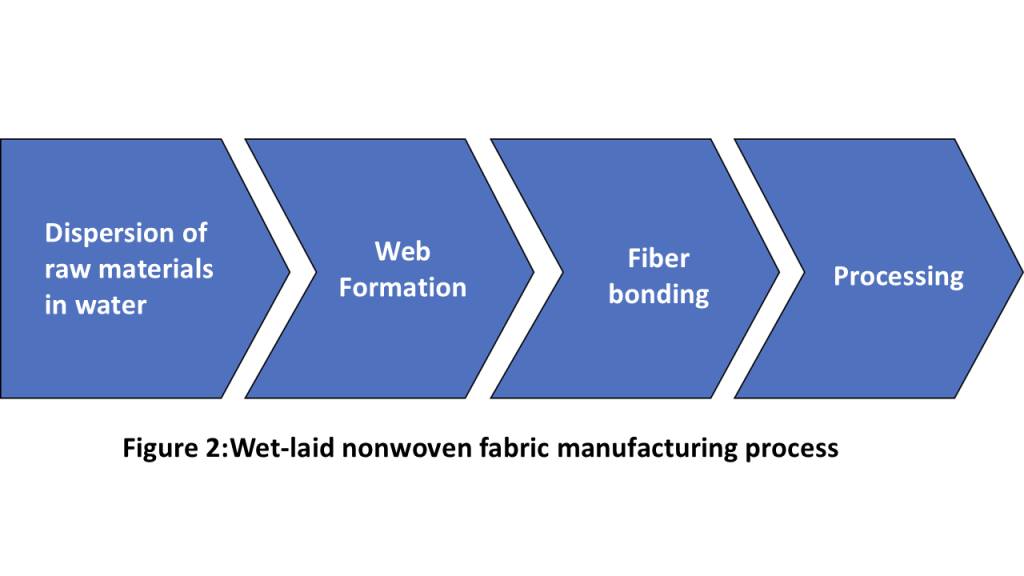
Let us examine each step in detail.
1. Raw Material Dispersion
In the dispersion process, fibers are separated to the single-fiber level in water to form a uniformly dispersed slurry. If dispersion is uneven, sheet formation will result in irregularities. Therefore, uniform dispersion is essential to prevent quality defects in subsequent processes.
2. Web Formation
The web formation process is the most distinctive stage in wet-laid nonwoven manufacturing. The slurry is formed into a sheet in a manner similar to traditional papermaking. Since fibers differ significantly in specific gravity and hydrophilicity, achieving uniform dispersion and sheet formation requires proprietary technology and expertise, making this a highly technical process.
3. Bonding
In the bonding process, pressure and heat are applied to the formed fiber sheet to remove water and bond the fibers together. The primary strength of wet-laid nonwoven fabric is mainly developed during this stage.
4. Finishing
Finally, additional heat treatment (calendering) or specialized chemical treatments are applied to impart required physical properties such as water repellency and flame resistance. For example, calendering conditions and bonding methods can significantly affect the strength, elasticity, and durability of the nonwoven fabric.
In this way, wet-laid nonwoven fabric is a highly versatile material whose functionality can vary greatly depending on the raw materials and processes selected at each stage.
If you would like to learn more about nonwoven manufacturing processes in general, please see the link below.
Types and Features of Nonwoven Manufacturing Processes
Typical Applications
What applications are wet-laid nonwoven fabrics used for? In fact, they are utilized in a wide range of fields, from everyday products such as food packaging paper to industrial materials such as high-performance filters. As mentioned earlier, their characteristics vary significantly depending on the fibers and processes used. For example, when manufactured without chemical adhesives, they are suitable for applications involving contact with the human body, such as food and medical products. When heat-resistant or chemical-resistant fibers are used, they become suitable for industrial applications where functionality is critical.
Table 2 summarizes typical applications of wet-laid nonwoven fabrics.
| Category | Specific Applications |
|---|---|
| Energy | Separators for primary and secondary batteries |
| Super insulation materials and thermal insulation for smartphones, etc. | |
| Process paper used in factory production lines | |
| Environment | Support materials for stabilizing thin-film liquid filters |
| Low-pressure-loss air filters using nanofibers | |
| Electromagnetic shielding materials for smartphones and tablets | |
| Agricultural materials such as biodegradable seedling pots | |
| Consumer Goods | Food packaging materials for sponge cakes, cream puffs, etc. |
| High-quality printing base materials for calendars and race bibs | |
| Medical & Welfare | Medical materials such as masks, gauze, and leukocyte removal filters |
Table 2: Typical Applications of Wet-Laid Nonwoven Fabrics
These are only a few examples, and wet-laid nonwoven fabrics have many other applications.
If you would like to learn more about applications of nonwoven fabrics in general, please see the link below.
Main Applications of Nonwoven Fabrics
Next-Generation Technologies in Wet-Laid Nonwovens
As described above, wet-laid nonwoven fabrics are present in many aspects of our daily lives, utilizing various technologies and manufacturing methods depending on the application. In recent years, however, even greater functionality has been demanded. To meet these needs, engineers engaged in wet-laid nonwoven technology are continuously developing new solutions.
In this section, we introduce specific needs and the innovative technologies developed to address them.
Nonwoven Fabrics Using High-Performance Fibers
The functionality of wet-laid nonwoven fabrics depends on the fibers used as raw materials. In addition to organic fibers, inorganic fibers can also be widely utilized. However, not all fibers are easy to process—some high-performance fibers are difficult to disperse uniformly and form into a web. Developing manufacturing technologies that enable the use of such challenging high-performance fibers is one of the major technical challenges in wet-laid nonwoven production.
One example is nonwoven fabric made from PPS (polyphenylene sulfide). PPS is a crystalline high-performance engineering plastic known for its outstanding properties. These include excellent heat resistance (melting point: 280°C; maximum continuous use temperature: 200–220°C), steam resistance, chemical resistance (stable against acids, alkalis, and organic solvents), thermal insulation, and flame retardancy (high self-extinguishing property with LOI = 34). However, due to difficulties in stable production, PPS had not previously been used as a raw material for wet-laid nonwoven fabrics. Through close collaboration with raw material manufacturers and persistent efforts to improve quality, Hirose Paper became the first company in Japan to successfully commercialize wet-laid PPS nonwoven fabrics and bring them to market. These materials are now used in energy, mobility, and other fields requiring high heat and chemical resistance.
Click here for more details about PPS nonwoven fabrics.
In this way, the cutting edge of wet-laid nonwoven development continues to advance the ability to process fibers that were previously difficult to handle, enabling the creation of high-performance nonwoven fabrics that were once unattainable.
Two-Layer Structures of Different Wet-Laid Nonwovens
In high-performance filtration applications, there is often a complex requirement: maintaining membrane strength without compromising separation performance. This requires combining the characteristics of both high-density and low-density nonwoven fabrics. To address this challenge, a heterogeneous two-layer nonwoven structure was developed, in which two fiber layers with different properties are laminated together.
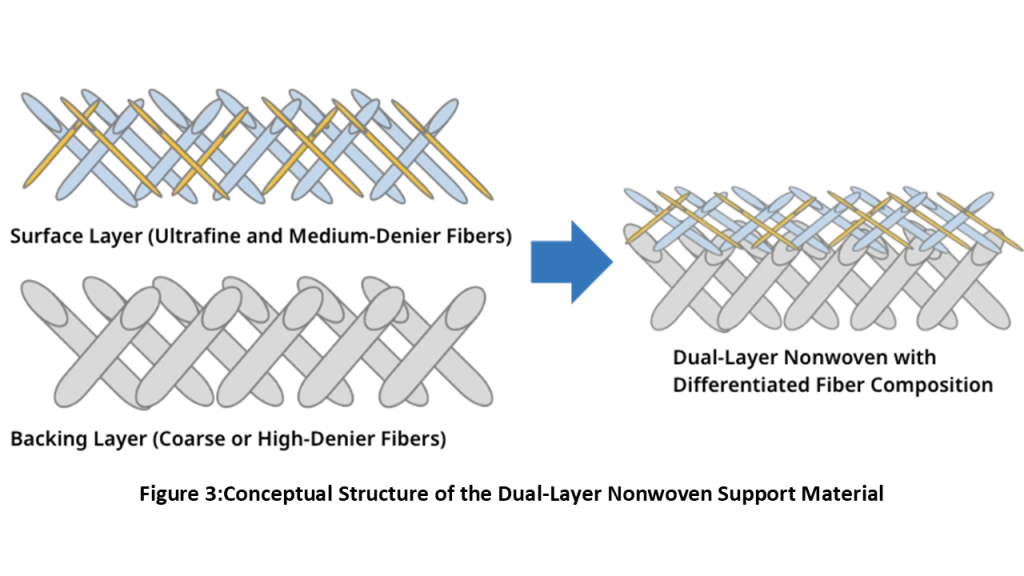
The surface layer uses fine-diameter fibers to form a dense layer with small pore sizes. In contrast, the back layer uses coarser fibers to provide thickness and mechanical strength, allowing each layer to fulfill a distinct role.
As a result, the surface of the heterogeneous two-layer nonwoven is smooth and features fine pores that prevent excessive resin penetration during membrane formation. Meanwhile, overall thickness and strength are ensured by the back layer, maintaining sufficient mechanical strength and pressure resistance as a support material. Because the two layers are integrated into a single structure, strong interfacial bonding is achieved, eliminating concerns about delamination.
While wet-laid nonwoven technology traditionally focused on single-layer structures, recent advancements in multilayer structures have made it possible to achieve new functionalities that were not attainable with conventional technologies.
Click here to learn more about heterogeneous two-layer nonwoven fabrics.
Contact Us About Wet-Laid Nonwoven Fabrics
Wet-laid nonwoven fabrics support our daily lives with their unique and diverse functionalities. However, because of their wide range of possibilities, it can sometimes be difficult to determine which applications or functions are suitable, or whether wet-laid nonwoven technology can solve specific technical challenges.
In such cases, please feel free to consult Hirose Paper. Since becoming the first company in Japan to commercialize 100% vinylon wet-laid nonwoven fabric in 1958, we have built extensive expertise as a pioneer in Japan’s wet-laid nonwoven industry through continuous R&D and mass production achievements.
Our specialized team will be happy to assist you with your technical challenges. We look forward to hearing from you.